Schooling is one of the most fulfilling experiences in a person’s life. In ideal circumstances school can equip us with the skills and expertise to join the real world. However, this is not without cost. Many students are worried about the cost of tuition. But what if there were ways to reduce these costs? What if you could earn two degrees in a shorter amount of time while spending less? Today, we will explore some of these options.
One option is a dual degree, where you receive two separate diplomas.
How Does A Dual Degree Program Work?
A dual-degree allows you to complete two academic degrees simultaneously, sometimes at different educational levels. This opportunity enables students to earn both credentials in less time than pursuing each degree separately. One of the most common options is often referred to as a 4+1 program, in which students complete a bachelor’s degree in four years and then spend one additional year earning a master’s degree.
If you’re a UConn undergraduate, you can pursue a Master of Public Health (MPH) alongside your bachelor’s degree through the accelerated MPH program (formerly known as FastTrack). To learn more about this opportunity, visit here.
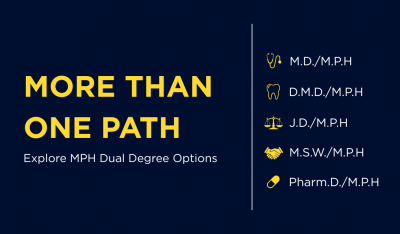
In addition to the accelerated MPH program, UConn Health offers several graduate and professional dual-degree pathways that allow students to earn an MPH concurrently with another degree. Available options include the MD/MPH, DMD/MPH, JD/MPH, MSW/MPH, and PharmD/MPH. These programs integrate coursework between the two degrees that help students complete both more efficiently while gaining valuable public health expertise and expanding their career opportunities.
Why should YOU do it?
Let us talk about why we should consider earning a dual degree.
Some of the benefits when one pursues this option.
1. Cost efficient
Dual degree programs are cost efficient for many reasons. Many universities often offer tuition reductions for students enrolled in combined programs. Students may also receive different graduate assistantships and/or other scholarships that help them cover their expenses. For example, in our accelerated MPH program, students can use their undergraduate financial aid to complete graduate courses. Furthermore, these programs are completed in a shorter timeframe, meaning students also save money in fewer semesters of tuition, living expenses, and the cost of extended schooling.
2. Greater Employability
A dual-degree is not just a degree; it’s a reflection of your hard work, commitment to discipline, and expertise over two distinct fields. Let’s be honest: it’s not easy to complete two degrees simultaneously while many struggle to complete a single degree. So, when you have a dual degree, it readily demonstrates that you are disciplined and comfortable taking on challenges and handling complex tasks. In addition to these skills, you will have built a foundation over two distinct disciplines that will undoubtedly give you a competitive advantage.
3. Enhanced Networking Opportunities
Dual-degree programs attract students from a variety of fields, including medicine, business, psychology, and data science. The dual-degree programs at UConn Health encourage collaboration at every step, providing ample opportunities for students to connect and build professional relationships. The connections formed in the program often result in lifelong friendships.
Graduate school is often the final stage of formal learning for most of us. The connections you build here have the potential to pay off for the rest of our lives.
4. Timesaving
Completing a bachelor’s degree followed by a master’s degree takes about six to seven years to finish, however; dual-degree programs offer you the opportunity to complete both in as few as four or five years. The accelerated timeframe allows you to look for and secure employment opportunities sooner than people who follow a traditional sequential path.
5. Greater mobility
The skills and expertise you gain in two distinct fields give you the choice to switch between two fields. The credentials you earn from dual-degree programs also open doors across multiple sectors in different regions. Before you enroll in any dual-degree programs, check to see if the program holds any accreditations as these can make your degrees more valuable to potential employers.
Dual-degree programs are not without challenges. They come with their unique set of obstacles. However, if you can take on those challenges, the rewards and freedom they offer are worth cherishing.
The Program in Applied Public Health Sciences offers several dual degree programs. If you’re interested in learning more about them, please visit here.